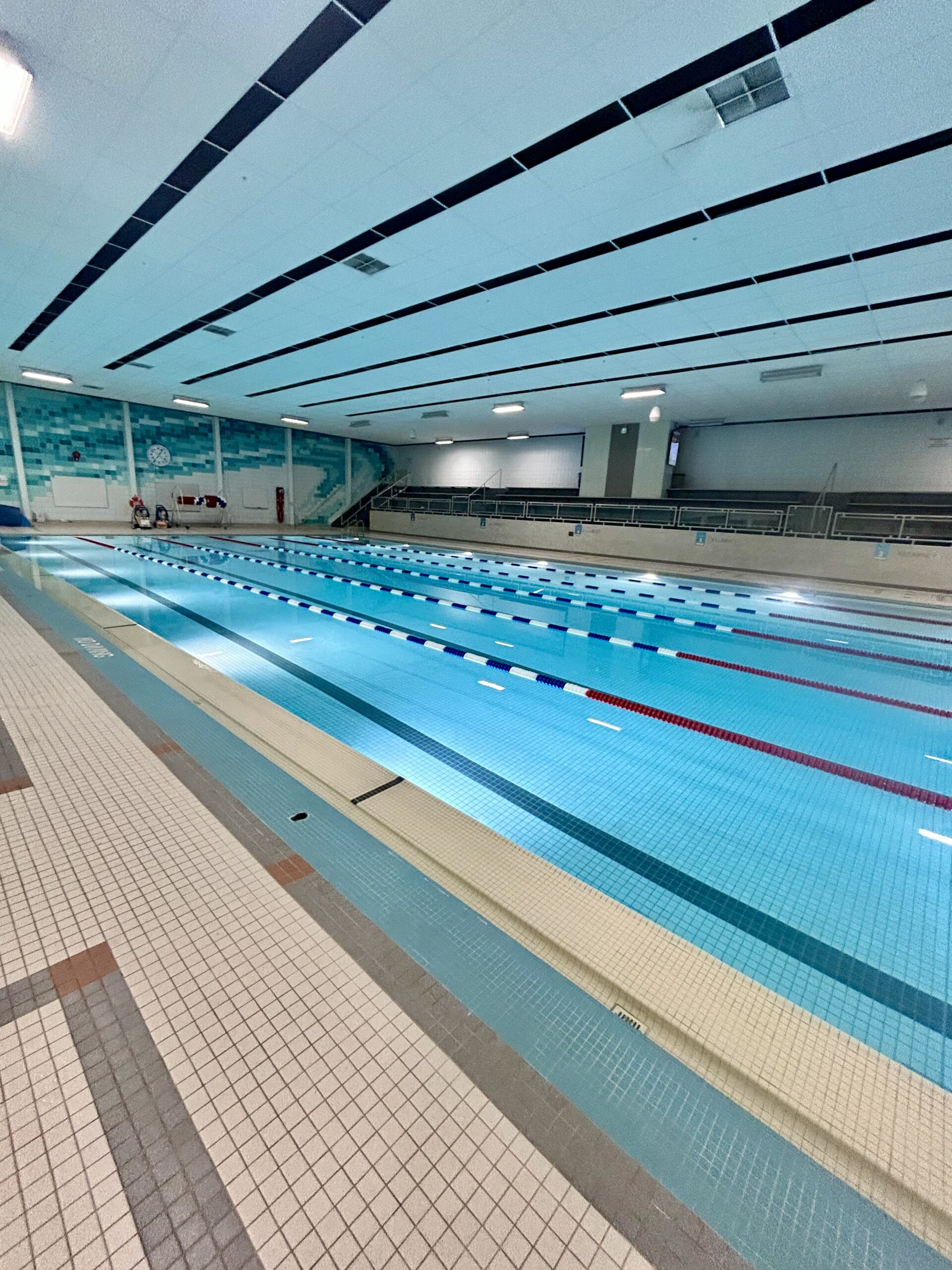
After a month back in the pool focusing on technique and settling into a regular swimming routine, our squads completed Critical Swim Speed (CSS) assessments last week. This data provides a benchmark as we begin adding swim fitness work alongside our technique focus. But what do the CSS numbers mean—and how can they help your swimming?
Here’s a look at CSS, why we use it, and a sample session to try.
What is CSS?
CSS stands for Critical Swim Speed. It’s an estimate of your threshold swimming pace, expressed as a time per 100m. Think of it as a comfortably hard effort that should be about the same as your 1,500m race pace.
For open-water swimmers and triathletes, developing this pace helps you swim faster over longer distances.
Why use CSS to guide your training?
CSS gives your training a clear reference point. Depending on the purpose of the set, you might swim at CSS pace, slightly faster or slightly slower. Your target pace, repeat distances and recovery times work together to create the intended training effect.
For sets at CSS pace, the aim is to hold a consistent pace with shorter recoveries rather than swimming each repeat as fast as possible and taking a long rest.
Remember, CSS is approximately your 1500m race pace, so holding it for a short repeat can feel relatively easy—especially early in the set. The challenge comes from accumulating distance at that pace with limited recovery. Early in a CSS set, swimmers might say, “I don’t feel like I’m working hard enough.” Partway through, those same swimmers are working hard and looking forward to the next rest!
The challenge is to keep your pace, rhythm, and technique consistent as fatigue builds. Starting faster than your target usually makes that harder.
How to determine your CSS?
Our usual assessment involves two time trials:
- A hard, evenly paced 400m
- After sufficient recovery, a hard 200m
We use the difference between those times to calculate your CSS pace:
CSS in seconds per 100m = (400m time − 200m time) ÷ 2
Convert both times to seconds before calculating. Note: If a person swims their 400 at a faster average pace than they swim their 200, you cannot do the calculation. On the rare occasion that this occurs, it’s usually due to the swimmer not being adequately recovered from the 400 TT effort. This person should re-test another day being sure they take at least 10 minutes rest after the 400 effort.
If you’re familiar with a Function Threshold Power (FTP) test on the bike, a CSS assessment serves a similar purpose in the pool: it estimates your current threshold so you can train at a pace appropriate to your fitness. Rather than guessing how fast to swim or trying to keep up with someone else, you have a personal target for your sets. This helps you hold a consistent effort, complete the intended distance and build endurance without starting too fast and fading. As your fitness improves, repeating the assessment helps you track progress and adjust your training pace.
An alternate way to assess
A 1500m time trial is another way to assess your CSS pace, looking at your average pace per 100m. However, that distance can feel daunting, and some swimmers are nervous enough to skip the session altogether. The 400/200m assessment offers a more approachable starting point.
Later in the season, we often include a 1500m time trial in our squad sessions. I also encourage swimmers to do 1500 TT on their own and compare their average pace with their CSS calculated from the 400/200 m assessment. The two 100m paces aren’t always an exact match, but they’re usually within a few seconds per 100m.
Where do CSS sets fit into your training?
A balanced week of swim training includes technique, threshold and endurance work. If you swim twice a week, one technique/endurance focused session and one CSS-focused session can be a useful starting point. If you swim three times a week, consider adding another endurance session with longer, steady-paced swims.
You can find our coached swim options here.
Sample CSS workout: “Stay on the beep”
This progressive set helps you practise pacing and see how your current CSS feels over longer repeats.
Total distance: 2500m
The instructions below assume a 25m pool and a FINIS Tempo Trainer Pro (aka “beeper”)
Warm-up: 800m
- 200m easy choice
- 200m with fins: kick on your back or side alternating every 25m
- 200m pull, with optional paddles, breathing every 3 or 5 strokes
- 200m swim, gradually building effort each 50 from “very easy” to “kind of quick”
Main-set: 1500m
Set your beeper in Mode 1 to your CSS pace per 25m. (Instructions below). Swim each interval at CSS pace (stay on the beep) taking a “one beep” recovery between intervals.
- 100m
- 200m
- 300m
- 400m
- 500m
Aim to reach each wall on the beep from the first length onward. Resist the temptation to get ahead early and “bank” time.
Cool-down : 200m
Setting your tempo trainer
- Turn on your Tempo Trainer Pro (bottom right button) and select Mode 1.
- Convert your CSS pace per 100m into seconds.
- Divide that number by four to get your target time per 25m.
- Set the device in mode 1 to beep at that interval.
For example, if your CSS is 1:51 per 100m. 1:51 converts to 111 seconds. Then, 111 ÷ 4 = 27:75 seconds per 25 m. This target pace is 27 seconds and 75 hundredths of a second per length. Mode 1 offers far more precision (hundredths of a second) than a pace clock! Your personalized virtual pacer is now ready to go.
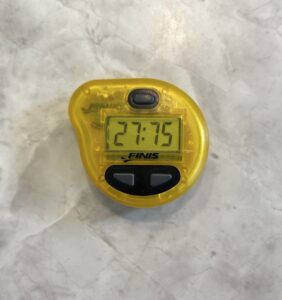
Insert the beeper that you set under your swim cap with the buttons facing outwards. When you start each interval, briefly press and release the single top button to start the timer as you push off the wall. You’ll hear a beep. Aim to reach the opposite wall on the next beep, then keep matching the beep at each end.
- On the beep: You reach the wall as it sounds.
- Ahead of the beep: You reach the wall before it sounds. (You’re swimming too fast)
- Behind the beep: It sounds before you reach the wall. (You’re swimming too slowly)
For a one-beep recovery, finish your repeat on the beep, rest until the next beep, then push off again. In this example, that gives you 27:75 seconds of rest.
What should you learn from the set?
If you can hold the beep throughout, with a challenging but controlled effort, your CSS is likely a useful training target.
If you start ahead of the beep and fade later, first work on pacing the early intervals more evenly. If you repeatedly struggle despite a controlled start, you likely need to reassess your target.
If the whole set feels comfortably below threshold (i.e. easy) effort, it may be time to reassess.
Remember, one session doesn’t tell the whole story—fatigue, technique and how you feel that day all matter. Use it as feedback.
Give it a go! Can you stay on the beep as the repeats get longer?
~Coach Mary